Act I · VI
Vultures of Sorrow
and Phantoms of Life
Told close, by candlelight.
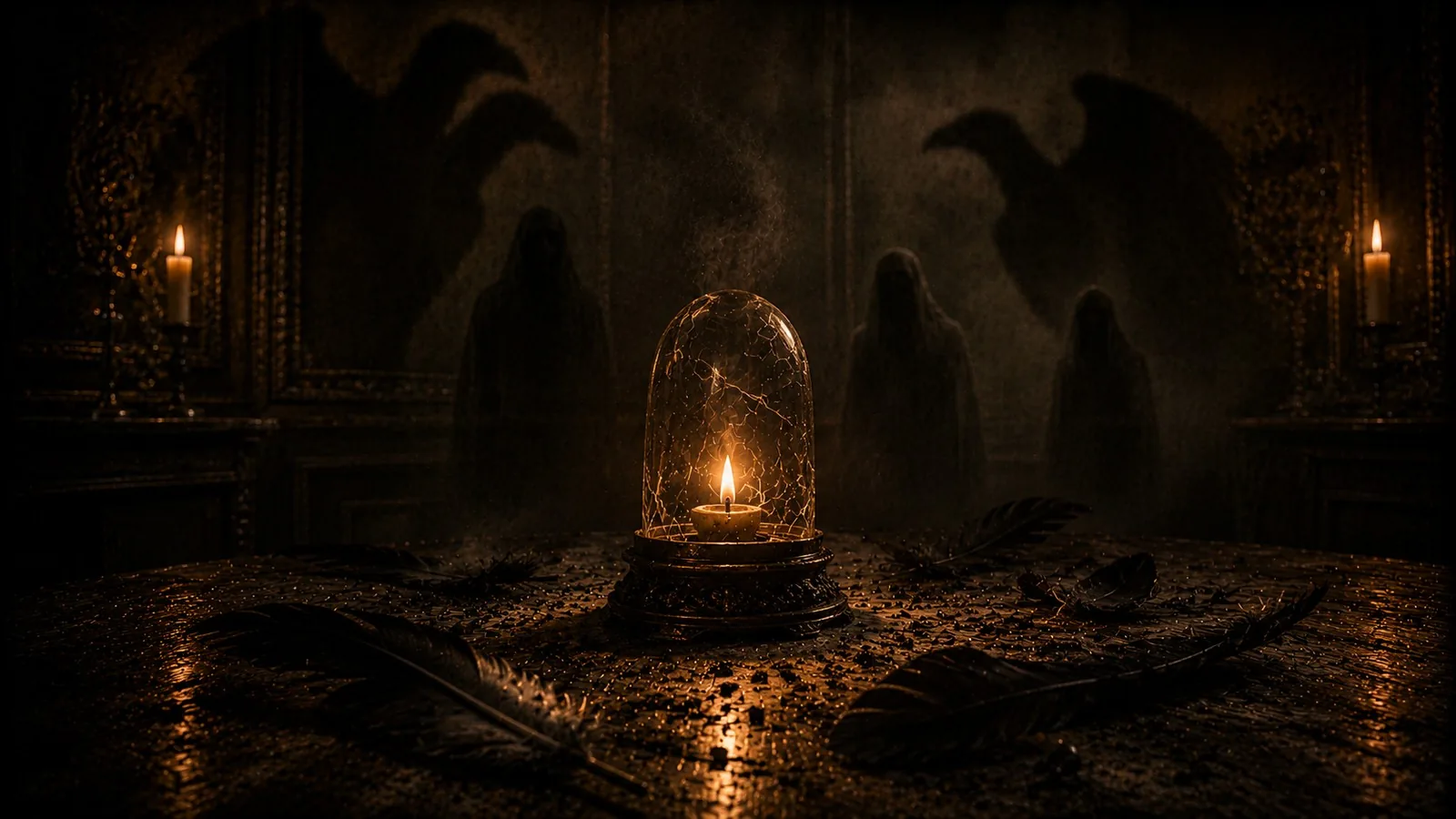
Some people do not think they are cruel. That may be the most frightening part. They have reasons. Systems. Contracts. Rules. Targets. Policies. They can explain every hard thing they do until it starts to sound almost clean. Almost reasonable. Almost necessary. But somewhere under all that language, a human being is still being crushed.
This song is about people who have learned how not to feel that. The ones who can make money from another person’s collapse and still sleep at night. The ones who stand behind procedure while someone else loses their home, their breath, their dignity, their last piece of hope. The ones who call it business, responsibility, consequence, discipline, justice — anything except what it is.
A world turned upside down. A world where money sits higher than mercy. Where control is called strength. Where indifference is called professionalism. Where people build armor so thick they stop hearing the sound of another soul breaking.
Vultures of Sorrow and Phantoms of Life is not only about obvious monsters. It is about the ordinary ones. The polite ones. The efficient ones. The ones with clean hands and dead eyes. They are not alive in the full sense. They function. They collect. They feed. They move through the world like phantoms wearing human shapes.
And still, the song does not end with them. Because somewhere in that room, under all the dust and pressure and fear, there is still a flicker. Something human. Something they could not buy, break, or bill into silence.
That is the part that rises.
Not with revenge. With light.
This song is about people who have lost contact with their own humanity. Not because they were born evil, necessarily. Maybe they adapted. Maybe they hardened. Maybe they told themselves the same story so many times that eventually the story became a shell around them. But the result is the same. They can watch someone suffer and feel nothing useful. They can profit from desperation. They can turn pain into paperwork.
That is what makes them vultures. Not because they look frightening. Because they feed where something is already wounded. And that is what makes them phantoms of life. They are moving, speaking, earning, functioning — but something essential has gone missing. The part that recognizes another person as more than debt, weakness, failure, or opportunity.
The Tavern version brings this down to the table. No abstract evil. No grand demon. Just people in a broken world, explaining their cruelty so well that they no longer recognize it.
And against that, one small impossible thing remains: a soul that still refuses to become like them. A light that survives the room. We are light.